
You know the feeling. Your air conditioner is running, but it’s not cooling. Or maybe it’s cycling on and off constantly, and your energy bill is creeping up. Before you panic and call for service, you might wonder what’s happening inside that sealed metal box. The truth is, most cooling problems stem from one thing: the refrigerant charge. And to diagnose it, professionals use one essential tool: an HVAC refrigerant gauges set. Think of it as the stethoscope and blood pressure cuff for your air conditioner.
What Are Refrigerant Gauges, and Why Do They Matter?
A refrigerant manifold gauge set is the primary diagnostic tool for any air conditioning, heat pump, or refrigeration system. It allows a technician to measure the pressure of the refrigerant inside the system’s two main sides: the high-pressure (liquid) side and the low-pressure (vapor) side.
The Heart and Lungs Analogy
Let me explain it this way: Your AC system is like a living creature. The compressor is the heart, pumping refrigerant (the lifeblood) through the coils (the lungs). The refrigerant absorbs heat inside your home and releases it outside. The pressures we measure with our AC gauges tell us if this process is working correctly.
- Low-Side Pressure (Blue Gauge): This is like the blood pressure returning to the heart. It tells us how well the system is absorbing heat. Too low, and the system is “starved.” Too high, and it’s “flooded.”
- High-Side Pressure (Red Gauge): This is like the blood pressure leaving the heart. It tells us how well the system is rejecting heat. Too high can indicate a blockage or overcharge; too low can point to a weak compressor.
By connecting these HVAC diagnostic gauges and comparing the pressures to the manufacturer’s specifications (which also consider outdoor temperature), I can tell if the system is properly charged, undercharged, overcharged, or has a more serious restriction or failure.
⚠️ Critical Safety Disclaimer
Working with refrigerant and HVAC systems is DANGEROUS. It involves high pressures, electricity, and potentially hazardous materials. This guide is for INFORMATIONAL PURPOSES ONLY to help you understand the process. Only EPA 608 Certified technicians should ever connect gauges, recover refrigerant, or service an AC system. Incorrect handling can cause severe frostbite, system damage, or even an explosive rupture.
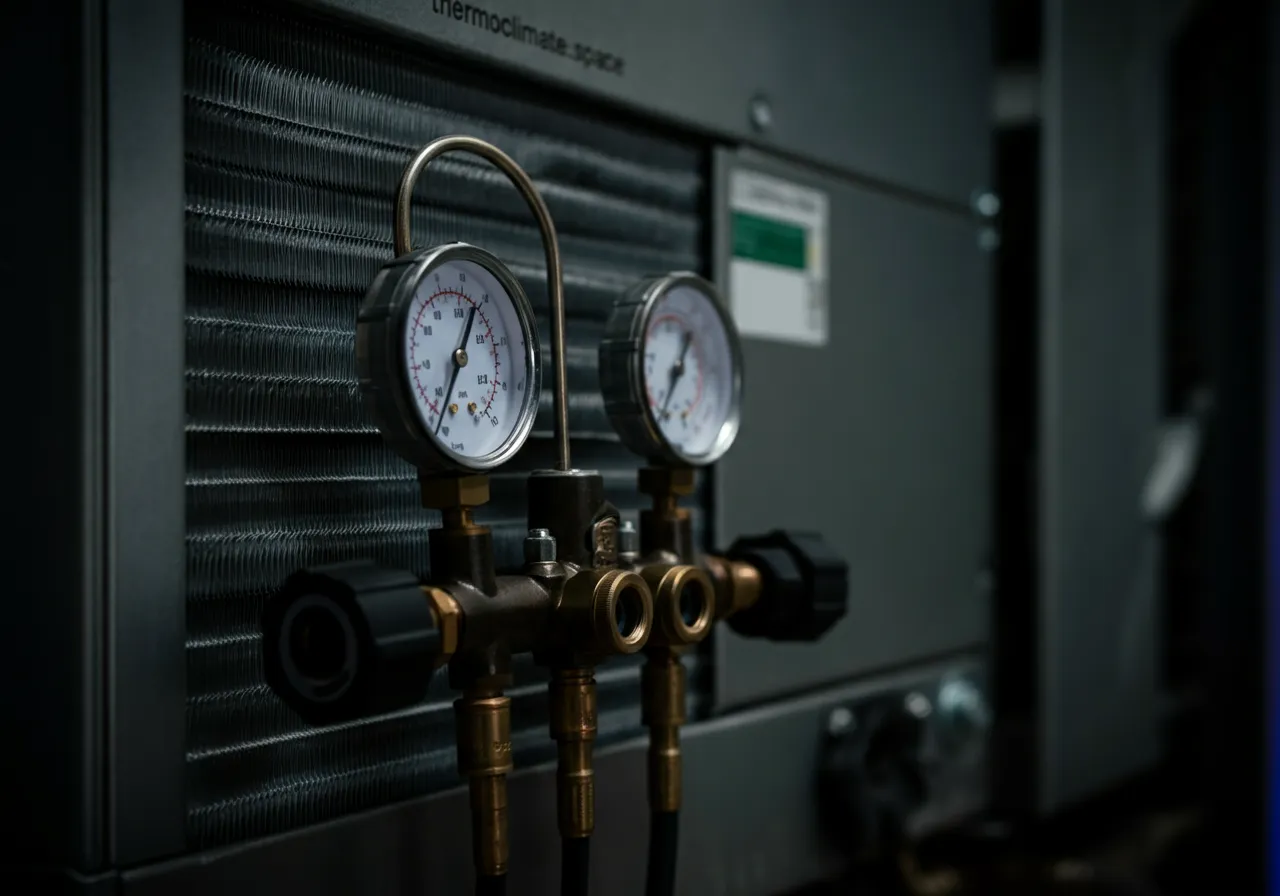
Anatomy of a Professional Gauge Set
Not all gauge sets are created equal. A professional-grade manifold gauge set consists of several key components:
- Manifold Body: The central hub with hand valves that control refrigerant flow.
- High-Pressure Gauge (Red): Typically reads from 0 to 500+ PSI.
- Low-Pressure Gauge (Blue): Reads from 0 to 250 PSI, often with a vacuum scale (in inches of Mercury, or “Hg) for evacuation.
- Hoses with Core Depressors: Color-coded hoses (red for high, blue for low, yellow for service/cylinder) that connect to the system’s service ports.
- Thermocouple or Ports for Pipe Clamps: For measuring superheat and subcooling—the critical calculations that determine the exact charge.
Digital vs. Analog Gauges: A Quick Comparison
The classic analog dial gauge is what most people picture. Today, digital manifolds are becoming the standard for precision. Here’s a quick breakdown:
| Feature | Analog Gauges | Digital Gauges |
|---|---|---|
| Readability | Require interpretation of a dial; parallax error possible. | Clear digital display; often more precise. |
| Functionality | Show pressure only. Superheat/subcooling calculated manually. | Often calculate and display superheat/subcooling automatically with connected clamps. |
| Durability | Very durable, but can be damaged by liquid slugging or drops. | More sensitive to physical damage and moisture. |
| Cost | Generally lower initial cost. | Higher initial investment. |
| Best For | Beginners learning fundamentals, backup set. | Professional technicians seeking speed and accuracy. |
What Your Technician is Looking For (The “Why” Behind the Gauge Readings)
When I hook up my gauges, I’m not just looking at numbers. I’m interpreting a story. Here’s what common pressure readings can indicate:
- Low Low-Side & Low High-Side Pressure: This is the classic sign of a low refrigerant charge, likely due to a leak. The system is starving for its working fluid.
- High Low-Side & High High-Side Pressure: Often points to an overcharge of refrigerant or poor heat rejection (dirty condenser coil, failed condenser fan).
- Low Low-Side & High High-Side Pressure: This indicates a restriction, like a clogged filter-drier or a pinched refrigerant line, blocking the flow.
- Normal Pressures but Poor Cooling: This is where superheat and subcooling calculations become essential, pointing to issues like a failing metering device or inefficient compressor.
For a deep dive into the science of superheat and subcooling, which is the true mark of a proper diagnosis, the ACHR News is an excellent industry resource for technical articles and training.
Frequently Asked Questions (FAQ)
Can I buy a gauge set and recharge my own AC?
Legally and safely, no. In the U.S., you must have an EPA 608 Certification to handle refrigerant, which is a regulated substance. More importantly, simply adding refrigerant without finding and fixing the leak, measuring superheat/subcooling, and verifying airflow is a guaranteed way to damage your expensive compressor.
What’s the difference between R-410A and R-22 gauges?
The gauges themselves are the same, but the service hoses and seals must be rated for the higher pressure of R-410A (which operates at nearly 1.5x the pressure of old R-22). Using R-22 hoses on an R-410A system is a major safety hazard. Most modern gauge sets are rated for R-410A and other common HFC refrigerants.
Why do my gauges sometimes frost up?
If you see frost forming on the low-side gauge or hose, it usually means refrigerant is rapidly expanding there, often due to a very low charge or a restriction at that point. It’s a visual clue of an issue and can also damage the gauge internals if liquid refrigerant enters them.
The Bottom Line
A refrigerant pressure gauge set is the window into the health of your cooling system. While it’s a tool best left in the hands of a certified professional, understanding what it does demystifies the diagnostic process. The next time a technician connects those colored hoses, you’ll know they’re not just checking “pressure”—they’re reading the vital signs of your home’s comfort system to provide an accurate, long-lasting repair.